

47th District Republicans Bylaws
Adopted 2025-03-29
ARTICLE II Purpose and Principles
ARTICLE IV Legislative District Organization Elected Officers
ARTICLE VI Conventions and Caucuses
ARTICLE VII Endorsements of and Contributions to Candidates
ARTICLE IX Code of Conduct and Discipline
ARTICLE X Parliamentary Authority and Governance
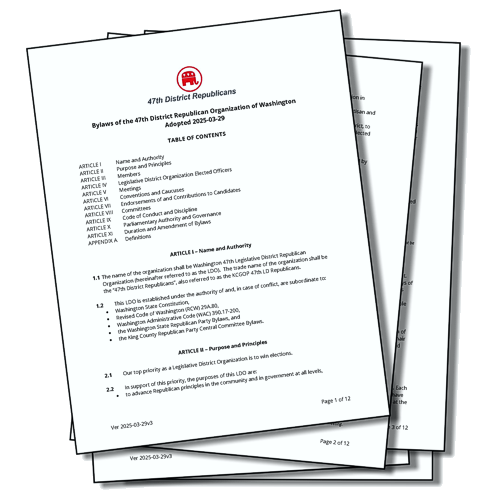
Click image to download PDF
of 47th District Republicans bylaws
1.1 The name of the organization shall be Washington 47th Legislative District Republican Organization (hereinafter referred to as the LDO). The trade name of the organization shall be the “47th District Republicans”, also referred to as the KCGOP 47th LD Republicans.
1.2 This LDO is established under the authority of and, in case of conflict, are subordinate to:
- Washington State Constitution,
- Revised Code of Washington (RCW) 29A.80,
- Washington Administrative Code (WAC) 390.17-200,
- the Washington State Republican Party Bylaws, and
- the King County Republican Party Central Committee Bylaws.
2.1 Our top priority as a Legislative District Organization is to win elections.
2.2 In support of this priority, the purposes of this LDO are:
- to advance Republican principles in the community and in government at all levels,
- to develop leadership skills in the membership that prepares them for participation in Republican Party activities,
- to support and promote elections and appointments of Republican-principled partisan and non-partisan candidates in all levels of government,
- to register new voters, activate current voters and volunteers to the Legislative District, to Republican candidate campaign-organizations, and to campaign organizations of selected nonpartisan offices/positions/initiatives/referendums,
- to fulfill duties prescribed by state law for the Legislative District,
- to endorse or recommend candidates for office at all levels of government,
- and to provide financial and logistical support to Republican candidates duly endorsed by the Legislative District.
2.3 The principles of the LDO are based on:
- our God-given rights and responsibilities,
- the US Declaration of Independence,
- the US Constitution as amended,
- the Republican Party national, state, and county platforms
- and Legislative District platforms.
Marketing messaging issued by or on behalf of the LDO shall adhere to these principles.
3.1 The Legislative District Organization shall be constituted in accordance with the bylaws of the King County Republican Central Committee (KCGOP) and consists of all the Republican PCOs in the Legislative District (LD) as voting members, along with officers, who have no vote if not also a PCO.
[Note: KCGOP Bylaw 7.1 says in part: “The Legislative District Organization (LDO) shall consist of all the Republican PCOs of King County in the Legislative District (LD) as voting members, along with officers, who have no vote if not also a PCO.”]
[Note; KCGOP Bylaw 3.3 says: “Appointed Precinct Committee Officers. In the event a precinct is without a Precinct Committee Officer, the County Chair shall fill a PCO vacancy by appointment upon the recommendation of the LDO Chair from among the registered voters residing therein.
A signed application may be submitted to the LDO Chair, who shall within 14 days notify the county chair and the applicant of their recommendation or lack thereof. The county chair shall, within 14 days of receiving such a recommended application, make or explicitly decline to make the appointment, and shall notify the applicant and all Executive Board members of the appointment or declination, and it shall be reported in the next board minutes. The appointed PCOs term of office shall begin forty-five days after the notification to the Executive Board.
The appointed Precinct Committee Officer shall have all the powers and responsibilities of the elected Precinct Committee Officer except as prohibited by law. An appointed Precinct Committee Officer may be removed only upon concurrence of the County Chair, the LDO Chair, and a two-thirds vote of the LD PCOs.”]
[Note: RCW 29A.80.031 says the “county chair of the county central committee shall fill the [PCO] vacancy by appointment. However, … the appointment may be made only upon the recommendation of the legislative district chair.”]
[Note: KCGOP Bylaw 3.4 says: “Each Precinct Committee Officer shall preside at all Precinct Caucuses and shall implement programs initiated by the County and LDO Chair.”]
[Note: KCGOP Bylaw 3.5 says: “Precinct Captain. For precincts without a PCO, the LDO Chair may appoint a Precinct Captain who is a registered voter outside that precinct but within the same LD and in King County, with approval by majority vote at a LD meeting. Notification for all such appointments shall be given to the Executive Board within 14 days, and it shall be reported in the next board minutes. They shall have all powers and responsibilities of Precinct Committee Officers except that they shall not be entitled to vote at meetings of the Central Committee or the LD meetings on matters limited to PCOs by the state constitution, state law, county party bylaws, or any applicable LD bylaws. A precinct captain may be removed at an LD meeting by majority vote with notice or two-thirds vote without notice.”]
3.2 Elected Precinct Committee Officer
Precinct Committee Officers (PCOs) who are elected in the primary election in even-numbered years are considered voting members of the LDO. PCOs represent the precinct in which they reside. PCO terms start on December 1 of the year of election and end on November 30 in the second year after election as specified by state law.
[Note: RCW 29A.80.051: “…The term of office of precinct committee officer is two years, commencing the first day of December following the primary.”]
[Note: RCW 29A.80.041(3): “When elected at the primary, the precinct committee officer shall serve so long as the committee officer remains an eligible voter in that precinct.”]
3.3 Appointed Precinct Committee Officer
Where no Precinct Committee Officer (PCO) was elected for a precinct, a PCO may be recommended by the LDO Chair and appointed by the County Chair, after an intervening biennial county reorganization meeting. The appointed PCO’s term shall begin 45 days after the approval by the King County Chair and shall end on November 30 in the next even-numbered year as specified by state law.
[Note: RCW 29A.80.031: “ When a vacancy in the office of precinct committee officer exists at a state primary, the vacancy may not be filled until after the organization meeting of the county central committee and the new county chair has been selected….”]
3.4 Precinct Captain
Precinct Captains (PCs) may be appointed by the LDO Chair for precincts which do not have a current PCO. PCs do not need to reside in the precinct for which they are appointed to represent. Notification for all such appointments shall be given to the County Executive Board within 14 days of appointment by the LDO Chair and accepted by majority vote of PCOs. PCs shall have all powers and responsibilities of PCOs except that they shall not be entitled to vote at LDO meetings on matters limited to PCOs by the state constitution, state law, county party bylaws, or any applicable LDO bylaws.
3.5 Removal of Members
PCOs, appointed or elected, may be sanctioned, but not removed, by majority vote of a quorum of LDO elected PCOs at a meeting of the LDO with 14 days’ notice. PCs may be removed by the Chair with majority vote of the LD Executive Board. The member sought to be sanctioned or removed shall be given full and fair opportunity to present evidence and argue in his own behalf.
4.1 The Elected Officers of the LDO shall be the Chair, Vice Chair, Secretary, and Treasurer. Each Elected Officer of the LDO shall be a registered voter, a resident of Legislative District 47, and have affirmed that they are a Republican and will uphold the US Constitution. They shall be elected at the biennial LDO organizational meeting to serve for two years commencing at the adjournment of that meeting, or until their successor is elected. Elected Officers shall turn over to their successors all records and access to all accounts necessary for a smooth transition and continued functioning of their office.
4.2 Chair
The LDO Chair shall:
- be responsible for LD activities within the district;
- be a signatory on all LDO accounts;
- preside over meetings of the LDO and ensure that each begins with an invocation and flag salute and may appoint a qualified parliamentarian to serve at LD meetings;
- be the temporary chair of the Biennial Organization Meeting of the Legislative District;
- represent the District and report District activities at each County Executive Board meeting;
- ensure maintenance of appropriate relations with other Republican organizations, community, business, professional, media (to include social media), local government agencies, and elected officials;
- make recommendations to the county Chair for PCO and PC appointments;
- be a member of all LDO committees except for the audit, discipline, and nominating committees (if applicable);
- operate LDO meetings with impartiality and follow current Robert’s Rules of Order so as not to influence PCOs in matters which require PCOs to vote, except to otherwise explain the nature or implications of such votes;
- call special or emergency meetings as necessary, giving 48 hours’ notice to the LDO if possible, when urgent action is needed to respond to an unexpected event or opportunity;
- and (to the extent practicable) create plans to designate areas, regions, and positions in the LDO as applicable.
4.3 Vice Chair
The LDO Vice Chair shall:
- assist and advise the LDO Chair in promoting Party activities;
- exercise all the powers and perform all the duties of the LDO Chair in their absence except appointment powers;
- be a signatory to all LDO accounts;
- and, temporarily assume the office of the LDO Chair when that office becomes vacant until a new chairman is elected.
4.4 Secretary
The LDO Secretary shall:
- be responsible for the minutes of all meetings of the LDO;
- maintain the contact lists of the LDO (elected officers, elected and appointed PCOs, precinct captains, and committees) and make available to LDO members by request;
- assist the LDO Chair to ensure that pending PCO appointments are managed and completed in accordance with the KCGOP bylaws time limits;
- keep a log of motions and rules passed by the LDO;
- ensure all governing documents, rules, and manuals are available at all meetings;
- ensure that a copy of the approved LDO bylaws is forwarded to the King County Central Committee within seven (7) days of adoption;
- and perform such further duties as the Parliamentary Authority, or LDO Chair shall prescribe.
4.5 Treasurer
The LDO Treasurer shall:
- be the custodian of all funds of the LDO;
- be a signatory on all LDO accounts;
- keep records of receipts and disbursements;
- shall disburse funds for routine budgeted items as directed by the LD Executive Board;
- shall be available to the County Audit Committee (but not be a member of the committee) and/or the WA PDC;
- be encouraged to attend free PDC training within 60 days of election;
- ensure that accurate and timely reports are filed with the Public Disclosure Commission;
- provide a monthly treasurer’s report to the LDO that includes itemized monthly and annual bank statements, income and expense statement, and balance sheet;
- and, upon leaving office, ensure a timely and orderly transfer of access, documentation and authority for all funds and government accounts (such as the PDC) by turning over such documents and providing access to the new Treasurer (or in the absence of a new Treasurer, to the Chair) within 14 days.
4.6 Removal of LDO Elected Officers
Elected Officers may be removed from office by two-thirds vote of elected PCOs at a meeting of the LDO with 14 days’ notice. The officer sought to be removed shall be given full and fair opportunity to present evidence and argue in his own behalf.
[Note: RCW 29A.80.061(2024): “The legislative district chair may be removed only by the majority vote of the elected precinct committee officers in the chair’s district.”]
4.7 Vacancies and Replacement of LDO Elected Officers
If an LDO elected officer shall die, resign, hold or assume a salaried elective public office as defined by state law, be removed from office, or cease to be a registered voter within the LD, that office shall thereupon be vacant. Temporary replacement of officers (other than the LDO Chair) shall be made by appointment and majority vote of the LD Executive Board. Ratification of replacement officers shall take place within 60 days by a majority vote of all LDO PCOs at a regular or special LDO meeting.
[Note: RCW 42.17A.005(43): “’Public office’ means any federal, state, judicial, county, city, town, school district, port district, special district, or other state political subdivision elective office.”]
5.1 Legislative District Organization (LDO) Biennial Organization Meeting.
The LDO shall hold an organization meeting in January of each odd-numbered year, replacing a regular monthly meeting, in accordance with state law and county bylaws.
The LDO Chair shall be selected in accordance with state law. The prior term LDO Chair shall be the temporary chair of the LDO organization meeting. The LDO organization meeting has the power by majority vote to elect their organization meeting permanent chair and secretary, adopt LDO bylaws if desired, elect the LDO Chair and any other officers prescribed by the LDO bylaws or otherwise deemed needed. The LDO shall elect members to various committees as requested by the KC GOP Executive Committee.
When the LDO organization meeting begins, the prior-term bylaws shall remain in effect until or unless replaced at the meeting.
The following shall be the order of business for the LDO biennial meeting:
- The former LDO Chair, as Temporary Chair, shall call the meeting to order.
- Follow the agenda as specified by the Temporary Chair.
- Financial report for prior term.
- Receive credentials report and verify a quorum of voting members is present.
- Adopt, by a majority vote, Rules and Order of Business.
- The LDO shall then elect a permanent meeting Chair and meeting Secretary.
- The LDO shall elect/approve other meeting officers as applicable (optional).
- Receive a report from the Bylaws committee (optional).
- Elect permanent officers for two-year term: LDO Chair and any remaining officers for the biennium required by the newly adopted bylaws.
- Elect a member to each county committee as specified or requested by the King County Executive Committee (optional).
- If practicable, elect any suggested Area Chairs or Regional Chairs.
- New business.
- With a vote of members present, adjourn the meeting.
[Note: RCW 29A.80.061says: “Within 45 days after the statewide general election in even-numbered years, the county chair of each major political party shall call separate meetings of all elected precinct committee officers in each legislative district for the purpose of selecting a legislative district chair in such district” 2024.]
[Note: It is the duty of the county chair to call the LD organization meeting (RCW 29A.80.061); this includes the date, time and location. “Ten days’ written notice shall be given for the LD biennial organization meeting” (KCGOP Bylaw 7.3.3).]
[Note: RCW 29A.80.051: State law (RCW 29A.80.061) specifies that “The district chair shall hold office until the next legislative district reorganizational meeting two years later, or until a successor is selected.” ]
5.2 Regular Meetings. Regular LDO meetings shall be held monthly through the calendar year except as otherwise ordered by the LD Executive Board. The established day and location for the LDO meetings shall be decided by the LD Executive Board.
5.3 Special Meetings. Special meetings of the LDO may be called at any time for specific purposes by the LDO Chair or two officers on two weeks’ notice, and the call shall state the purpose of the meeting. A special meeting shall be called by the LDO Chair upon receipt by him of a petition therefor, signed by a majority of the total number of the LDO voting members. Such meetings shall be held between 14-21 days after the call is sent. The LDO Chair shall preside as Chair of all such meetings, except in the case of any meeting called for removal of the LDO Chair where the Vice Chair shall serve as Chair of the meeting.
5.4 Closed Meetings. Attendance at closed meetings, or a closed-session segment of a meeting, shall be restricted to members of that meeting, committee, or organization unless otherwise approved by that group.
5.5 Quorum. A quorum shall consist of 20 percent of the voting membership.
6.1 Legislative District Caucuses shall be held in accordance with the rules of the King County Republican Party and Washington State Republican Party.
6.2 Delegates to King County Republican Party and Washington State Republican Party conventions shall be elected by majority vote of those present (not just voting LDO members) at Pooled Precinct Caucuses and Legislative District Caucuses.
7.1 The LDO may make endorsements for candidates for public office based on a majority vote of the LDO, in the same spirit of fairness and Republican principles as the county party. Any member of the LDO may propose candidates or initiatives for endorsement to the LDO, accompanied by a written or verbal rationale. Such proposals shall be prioritized on the meeting agenda and require a majority vote of the LDO voting members present to adopt. In the event of a tie, the Chair shall cast the deciding vote. The timing of any such endorsements shall be determined by a majority vote of the LDEB.
[Note: KCGOP Bylaw 9.4 says: “…Support of Candidates.
The King County Republican Party may endorse, recommend, recognize, and/or provide assistance only to a person running for elected office
- that identifies as a Republican, or
- is running in a non-partisan race, or
- has no identified-Republican in the race after the filing period deadline….”]
[Note: KCGOP Bylaw Article II says: “…The principles of the Republican Party are found in:
- our God-given rights and responsibilities,
- the US Declaration of Independence,
- the US Constitution as amended,
- the Republican Party national, state and county platforms….”]
7.2 Giving to State Candidates or PropositionsContributions supporting LD or statewide candidates or political propositions (such as initiatives) must be approved by a majority of LDEB members. Proposed contributions which exceed the authorized limit of the LDEB shall require a majority vote of the LDO PCOs.
7.3 Giving to Federal Candidates
When giving to candidates for federal offices, such as those running for US President, US House of Representatives, or US Senate, the LDEB shall limit contributions to the amounts specified by the Federal Election Commission, and report the donations to the Washington State Republican Party (for tracking of aggregate party contributions toward each campaign).
7.4 Special Committee for Large Contributions
Should the LDEB and/or the LDO voting members as a group desire to contribute to candidates or causes which would exceed legal limits (state or federal) for contributions from an LDO, there shall be formed a special committee for the purpose of facilitating such contributions. The special committee shall determine the rules governing their formation in accordance with state and federal laws, and may establish a separate bank account through which to receive and disperse funds according to their purpose. The special committee shall report all activities to the LDEB for final approval by a majority vote of the LDEB.
7.5 Prohibition of “Earmarking” of Funds
In accepting contributions to the LDO, or making disbursements to candidates or political propositions, the LDO will not take part in any “earmarking” of funds.
[Note: RCW 29B.40.020 (4) says, “4)(a) Notwithstanding subsection (2) of this section, no bona fide political party or caucus political committee may make contributions to a candidate during an election cycle that in the aggregate exceed (i) eighty cents multiplied by the number of eligible registered voters in the jurisdiction from which the candidate is elected if the contributor is a caucus political committee or the governing body of a state organization, or (ii) forty cents multiplied by the number of registered voters in the jurisdiction from which the candidate is elected if the contributor is a county central committee or a legislative district committee. (b) No candidate may accept contributions from a county central committee or a legislative district committee during an election cycle that when combined with contributions from other county central committees or legislative district committees would in the aggregate exceed forty cents times the number of registered voters in the jurisdiction from which the candidate is elected.]
[Note: RCW 29B.40.070 (1)(a) says, “(1) It is a violation of this title for any person to make, or for any candidate or political committee to accept from any one person, contributions reportable under RCW 29B.25.100 in the aggregate exceeding fifty thousand dollars for any campaign for statewide office or exceeding five thousand dollars for any other campaign subject to the provisions of this title within 21 days of a general election. This subsection does not apply to (a) Contributions made by, or accepted from, a bona fide political party as defined in this title, excluding the county central committee or legislative district committee]
[Note: RCW 42.17A.005 (6)(c) says, “…There may be only one legislative district committee for each party in each legislative district.]
[Note: RCW 42.17A.405 (4) says, “.(a)…no bona fide political party or caucus political committee may make contributions to a candidate during an election cycle that in the aggregate exceed (i) eighty cents multiplied by the number of eligible registered voters in the jurisdiction from which the candidate is elected if the contributor is a caucus political committee or the governing body of a state organization, or (ii) forty cents multiplied by the number of registered voters in the jurisdiction from which the candidate is elected if the contributor is a county central committee or a legislative district committee. (b) No candidate may accept contributions from a county central committee or a legislative district committee during an election cycle that when combined with contributions from other county central committees or legislative district committees would in the aggregate exceed forty cents times the number of registered voters in the jurisdiction from which the candidate is elected.]
[Note: RCW 42.17A.420 (1) says, “.(1) It is a violation of this chapter for any person to make, or for any candidate or political committee to accept from any one person, contributions reportable under RCW 42.17A.240 in the aggregate exceeding fifty thousand dollars for any campaign for statewide office or exceeding five thousand dollars for any other campaign subject to the provisions of this chapter within twenty-one days of a general election. This subsection does not apply to: (a) Contributions made by, or accepted from, a bona fide political party as defined in this chapter, excluding the county central committee or legislative district committee]
[Note: FEC guidelines as of 01/04/2024 say, “A state party committee and local party committees within that state are presumed to be affiliated. That is, all contributions received and made by local party committees count against the state committee’s limits. This means that the state committee and local committees together may receive a maximum of $10,000 per calendar year from any one individual or non-multicandidate committee contributor. Similarly, the state committee and local committees together may not contribute more than $5,000 to a candidate per election, assuming the state party committee has qualified as a multicandidate committee.” Reference: https://www.fec.gov/help-candidates-and-committees/taking-receipts-political-party/affiliation-between-party-committees/]
[Note: FEC guidelines as of 01/04/2024 say, “As a general rule, the limits on contributions to federal candidates and candidate committees apply separately to each election in which a candidate participates—primary, runoff or general.” Reference: https://www.fec.gov/help-candidates-and-committees/making-disbursements-political-party/contributions-made-party-committees/]
8.1 Legislative District Executive Board (LDEB)
The Legislative District Executive Board (also known as the “LDO Board” or “The Board”) shall consist of the elected LDO Officers, plus 4 to 7 registered voters from the LD community, including PCOs, PCs, and non-PCOs. The duties of the LDEB may include, but are not limited to:
- coordination of monthly and special meetings, initiative signature campaigns, LD marketing campaigns, and other such events;
- maintenance of an LD website, newsletter, social media presence, and other such communication tools as approved by the LDEB;
- create committees for specific purposes and appoint committee chairs and members;
- recruit potential candidates for office with input from LDO members and/or special committees;
- present an LDO annual budget to the PCOs for approval, upon two weeks’ notice at a regular or special meeting in December or January of each year;
- approval of and reimbursement for expenses related to LDO operations and activities in accordance with the annual budget, up to a limit of $2,000 per instance; single disbursements greater than $2,000 shall require a majority vote of the PCOs;
- and other such activities as are necessary for the operation of the LDO.
The LDEB shall seek input from LDO members regarding meeting topics, campaign efforts, special events, and other activities as may be relevant to the operation of LDO business.
[Note: WSRP Bylaw 10.1 says: “Establishment: A legislative district committee may be established for each legislative district within the State of Washington. A committee established pursuant to this Article 10, and no other committee, is a legislative district committee of the Washington State Republican Party. Terms of officers and members of such legislative district committees shall expire at the end of every even-numbered year.”]
[Note: WSRP Bylaw 10.3 says: “Creation of the Legislative District Committee where county central committee bylaws make provision for their creation
10.3.1 Single County Districts: Where Republican Party County Central Committee Bylaws make provision for the establishment of a legislative district committee for a district wholly within that county, that legislative committee shall be organized and operated in accordance with those bylaws.”]
8.1.1 Addition and Removal of Members of the LDEB
Additional members may be nominated by any member of the LDEB and must be approved by a simple majority of the LDEB. Members may be removed from the LDEB at any time for any reason, with 10 calendar days’ notice and opportunity to respond, by a two-thirds vote of the LDEB.
8.1.2 LDEB Term
LDEB members who are not elected LDO Officers may serve on the LDEB for an unlimited term until they voluntarily resign from the LDEB or are removed by a majority vote of the LDEB.
8.1.3 LDEB Quorum
A quorum for the LDEB shall be at least 50% of LDEB members, with the Chair having any tie-breaking vote.
8.2 Special Committees
Special Committees of the LDO may be created by majority vote at any LDO meeting. Such committees shall report to the LDEB regarding structure, purpose, and activities.
8.3 Standing Committees
Additional permanent committees may be created by the Chair and/or the LDEB for purposes such as the creation, oversight, and/or auditing of the budget; creation and execution of marketing efforts; and other such purposes as may be in the interests of the LDO.
9.1 Code of Conduct
No member should make a personal or ad hominem attacks against another member of the LDO. No member should intimidate, issue threats, or bully another member of the LDO.
9.1.1 No member shall run for office representing any other party than Republican. No member shall fundraise for, become a member of, or otherwise publicly support candidates of non-Republican parties.
9.1.2 Members violating this code of conduct may be subject to the disciplinary actions as detailed herein.
9.2 Discipline
Except as otherwise provided herein, discipline for cause shall be decided by the LDO members with due process as determined by majority vote. Possible penalties include, but are not limited to: censure, removal of voting rights in any meeting of the LDO or committees, ineligibility to participate in a Precinct Caucus or to serve as an automatic or elected delegate to the King County Republican Convention, and ineligibility to serve on any other committees established by or under the authority of the LDO.
9.3 Notice and Hearing
The member subject to discipline shall receive written notice from the Chair of the allegations at least 14 calendar days prior to the meeting where the matter will be considered. A copy of such notice shall be filed with the LDO Secretary. The notice shall specify the alleged conduct and provide supporting evidence. The member shall be afforded a full and fair opportunity to present evidence and argue in their own defense at the meeting. Procedures for hearings and meting discipline are outlined in the articles related to the various positions, above.
[Note: Robert’s Rules of Order Newly Revised, RONR 12th ed., 61:1 says: “an organization or assembly has the ultimate right to make and enforce its own rules, and to require that its members refrain from conduct injurious to the organization or its purposes. No one should be allowed to remain a member if his retention will do this kind of harm.”]
10.1 Parliamentary Authority. In all instances, when not inconsistent with the provisions of these Bylaws, and/or optional LDO-adopted Special Rules and/or Standing Rules (defined in Appendix A), the current edition of Robert’s Rules of Order Newly Revised shall govern the LDO and all Committees a part thereof.
10.2 Video and Audio Recording. The Republican Party is a private association. In all of its meetings, participants and guests should be respectful of those in attendance and of the activities being conducted. If the body votes that the use of video or audio recording devices is disruptive, the Chair of the meeting may establish such reasonable restrictions upon the placement and operation of video and audio devices as the Chair deems appropriate to ensure the orderly conduct of the meeting. Those who refuse to comply with the Chair’s direction may be removed from the meeting. RCW 9.73.030(3) allows meetings to be recorded upon announcement to those present.
10.3 Electronic Meetings. LDO monthly meetings, committees or the LD Executive Board, may meet via teleconference or videoconference as determined by the Chair of that body or the majority members of that body by majority vote.
10.4 Conflict of Interest. The elected officers shall not unduly benefit by their position.
11.1 Duration of Bylaws. These bylaws shall remain in full force and effect from the date of their adoption until such time as they are amended, revised, or replaced by a subsequent action of the LDO. At no time shall the LDO operate without governing bylaws. In the event of a delay or failure to adopt new bylaws at the biennial organization meeting, the existing bylaws shall continue to govern until a new set is duly adopted.
11.2 The Bylaws may be amended at any regular or special meeting of the LDO by a two-thirds vote of all PCOs and that a 10-day previous notice been given. Any proposed amendments or bylaws revision shall be submitted to the LDO Chair not later than 20 days prior to the convening of any LDO meeting during which the proposal is to be considered. A copy of any proposed amendment shall be provided electronically to each member with the official call.
[NOTE: This article does not apply to the adoption of the Bylaws at the LD Biennial Organization Meeting, which shall be accomplished by a majority vote per Robert’s Rules of Order Newly Revised.]
A.1 “Central Committee” refers to the King County Republican Central Committee, which consists of all Republican Precinct Committee Officers of King County.
A.2 “Precinct Committee Officer” refers to both an elected and appointed Republican Precinct Committee Officer.
A.3 “Executive Board” refers to the KCGOP Elected Officers and the LDO Chairs.
A.4 “KCGOP” refers to the King County Republican Party.
A.5 RCW refers to the state law, the Revised Code of Washington.
A.6 RONR refers to Robert’s Rules of Order Newly Revised, current (12th) edition.
A.7 LD refers to the Legislative District – the physical District and the constituents and residents therein.
A.8 LDO refers to the Legislative District Organization – the members of the organization, both elected and not elected.
A.9 LDEB refers to the Legislative District Executive Board, as defined above.
A.10 “Special Rules” (or “Special Rules of Order”) are rules adopted by the membership and are written down (but are not considered part of these bylaws). They have precedence over Robert’s Rules of Order.
A.11 “Standing Rules” (or “Standing Rules of Order”) are administrative procedures which are often “housekeeping rules” which govern how a group operates. Any such Standing Rules do not have precedence over Robert’s Rules of Order.